Somero Laser Screed Training: Big-D Logistics Elevates Precision
On any concrete pour, the final finish tells the whole story. You can have the right drawings and the best materials, but if your laser screed isn’t dialed in and the crew isn’t trained on the machine, those inconsistencies will show in the slab.
At Big-D Companies, we have been anchoring the West’s most significant builds since 1967. We view our Logistics department as a centralized engine that supports our brands and protects the craft. Recently, our Logistics team put this philosophy into practice, hosting a two-day Somero Laser Screed training at our North Salt Lake facility.
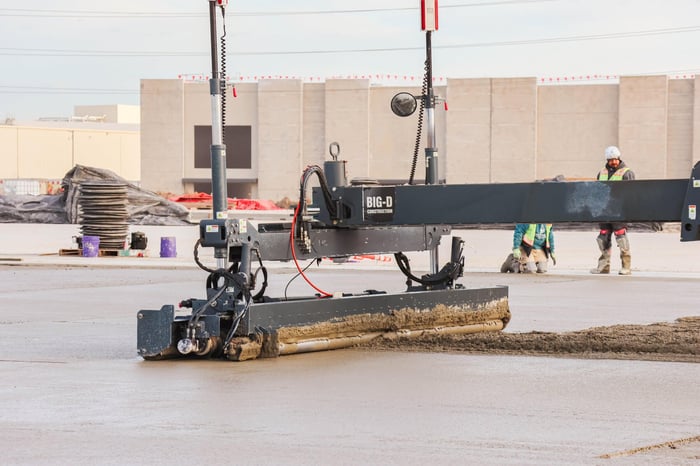
What is a Laser Screed?
For those outside of the concrete trade, a Laser Screed is the difference between a “standard” floor and precision engineering.
While traditional manual screeding relies on physical labor and hand-leveling, this machine utilizes a telescoping broom and a sophisticated laser-based guidance system. A transmitter sends a 360-degree plane of light across the jobsite, which sensors on the machine receive to adjust the leveling plow and vibrator hundreds of times per minute.
By removing the human-eye element of “eye-balling” the grade, we ensure the finished surface is consistently flat from one end of the building to the other. The result is a denser, more durable slab that can withstand the rigors of high-reach forklifts and heavy industrial traffic.
The training focused on making sure crews from McAlvain, Martin-Harris, and Big-D Self Perform have the technical backing they need when it’s time to pour.
Strengthening Operational Consistency
As a centralized resource supporting all Big-D companies, the Logistics team coordinated the training to strengthen operational consistency and improve equipment performance.
The goal was simple. Share best practices, strengthen internal service capabilities, and ensure crews across the company can rely on the same high standards in the field.
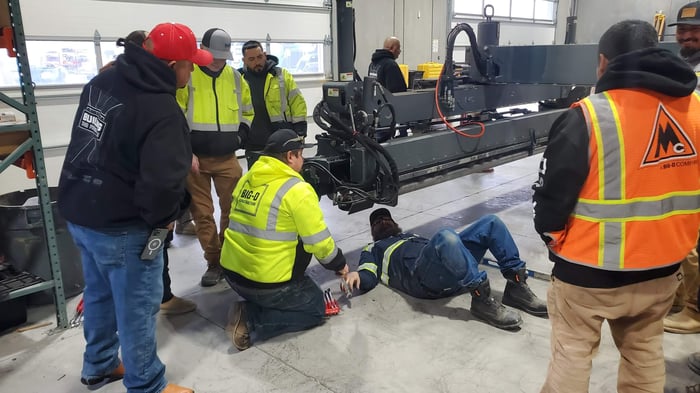
The training was led by Somero field support technicians Leo Oury and Aaron Cox, who bring a combined 40 years of industry expertise to the table. Our teams focused on several critical mechanical and operational fundamentals:
- Machine Calibration: Conducting laser checks and establishing accurate grades.
- Mechanical Fundamentals: Preventive maintenance to reduce downtime in the field.
- Operator Responsibility: Prioritizing safety and precision during joystick operation and drive-around orientation.
- Communication Protocols: Setting up headsets and site-specific protocols to ensure seamless execution.
By managing these technical requirements and service capabilities internally, we reduce potential downtime and ensure our laser screeds continue operating at peak performance.
Equipment Backed by Expertise
To ensure our gear meets our standards, we prioritize hands-on training that keeps our maintenance in house. Earlier this year, our Logistics team attended Whiteman training in Texas to master trowel repair and service. Whether it’s a laser screed or a power trowel, we are committed to building the inernal service capability necessary to keep our projects moving forward.
We do not adopt technology for the sake of it. We invest in the tools and training that make jobsites safer and results more predictable for our clients. Our ongoing investment in the Somero service agreement ensures our fleet remains calibrated, maintained, and ready to perform at the highest level.
FAQs
How does a laser screed improve floor flatness?
Unlike traditional manual leveling, which relies on the "human eye" and physical labor, a laser screed uses a 360-degree laser transmitter to guide the machine's leveling plow. This allows for adjustments to be made hundreds of times per minute, ensuring a surface that is consistently flat and level from edge to edge.
Why is precision concrete leveling important for modern industrial buildings?
Modern facilities often utilize high-reach forklifts, automated picking systems, and heavy industrial traffic. Even minor deviations in floor flatness can cause equipment instability or premature wear on the slab. High-precision screeding ensures the floor can handle the technical demands of 21st-century logistics.
What are the primary benefits of training crews on the Somero Laser Screed?
Consistency: Ensuring every crew across the Big-D family of companies follows the same high standards.
Efficiency: Reducing downtime through better machine calibration and mechanical fundamentals.
Safety: Mastering joystick operations and communication protocols to keep the jobsite secure.
similar articles
Emotional Intelligence: The Hidden Skill Strengthening Today’s Jobsites
Mar 16, 2026Jobsites today look nothing like they did twenty years ago. Technology keeps moving, safety keeps improving, and the demand for skilled teams grows by the
Industrial Construction on Active Jobsites: The OCI Expansion
Mar 20, 2026Industrial construction on active jobsites often takes place inside facilities that are already operating at full capacity, where production, logistics, and
Women in Construction Week 2026: Vai Taimi
Mar 05, 2026When Vai Taimi first walked onto a Martin-Harris Construction jobsite, she wasn’t there to lead, she was there to learn,
Women in Construction Week 2026: Lori Bartho
Mar 04, 2026When Lori Bartho decided to step away from a long career in education, she did not expect construction to become her next chapter. She wanted a healthier