Luxury Homebuilding: When Craftsmanship Defines Luxury
Luxury homebuilding is not defined by size or location alone. It is the combination of precision, creativity, and craftsmanship that makes a home feel timeless and intentional. Clients expect elevated finishes and enduring quality, along with spaces designed to perform as beautifully as they look. Delivering on those expectations requires more than standard processes. It requires a more thoughtful pace of work, tighter collaboration between owners, architects, designers, and builders, and craft teams capable of solving complex challenges in real time.
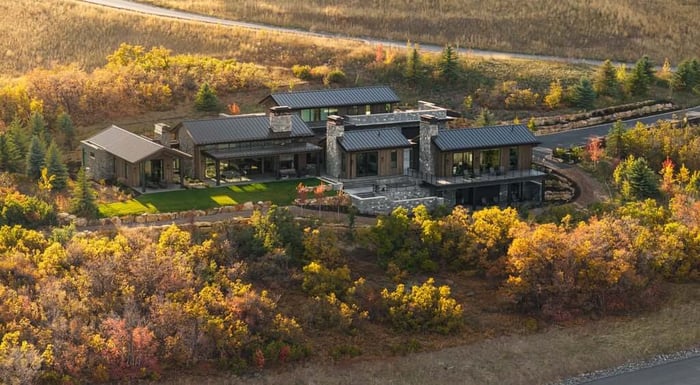
At the start of any luxury homebuilding project, design intent sets the stage. Architects provide the bones of the structure, while interior designers shape the lived experience. Together, they help homeowners visualize outcomes they may never have imagined and guide each custom residence from concept to reality.
“Every room you go in, it’s something different and unique,” said Jeff McKee, Project Director for Big-D Midwest’s Residential Collection. “Whether it be a fun kitchen backsplash tile, a bathroom’s unique wall covering, or patterned tile used to make the laundry room interesting, no two spaces repeat. Those details are what separate these homes from the more traditional production home.”
These layers of detail make homes feel personal and specific to their owners. From quartz countertops with bold veining to paneled refrigeration that blends seamlessly into cabinetry, the finishes are not just decorative. They establish the identity of the home and reinforce the sense that every decision was made with intention.
McKee also described the importance of pacing the process differently than production housing.
“It has to be perfect. In these homes, we take a step back, slow down, and focus on every detail, because these owners may live here for the rest of their lives. It has to be flawless.”
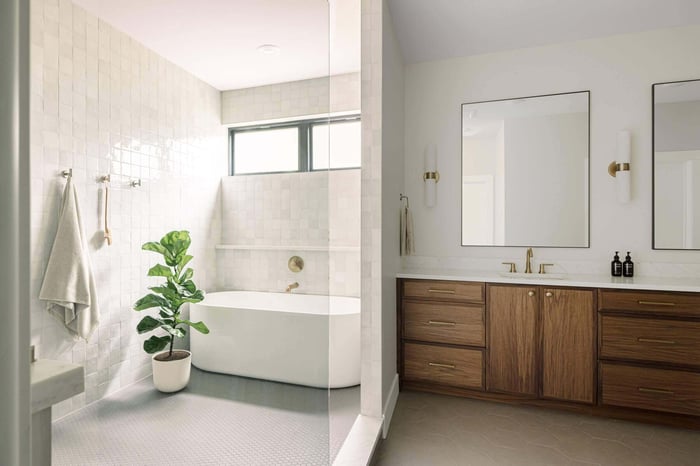
Interior designers play a critical role in bridging architectural drawings and field execution. While architects often provide floor plans and elevations, designers create room-by-room interior elevations that show where every transition, fixture, and surface lands. Those drawings are essential for coordination, precision, and helping homeowners confidently commit to selections before work begins.
“Homeowners may only build once in their lifetime, so they’re likely unfamiliar with the build process,” McKee said. “Renderings and 3D walkthroughs help, but homeowners still want to see things in person. This may require us to pause as the team works to find the right product selection. The key is walking step by step with them through the process, informing them of critical decision timelines, and keeping the schedule flexible enough to absorb some indecision.”
Clear alignment early on between owners, designers, architects, and builders is essential. Establishing how decisions will be made and when selections will be locked helps maintain momentum without compromising the integrity of the home.
Executing luxury work in the field requires precision, patience, and often a level of artistry that fades into the background once the project is complete. Nowhere is that more evident than in Big-D Signature’s work in Jackson Hole, where reclaimed timber defines the character of high-end custom homes.
Shandon Brinkerhoff, Vice President of Big-D Signature, described the origins of their timber craft team.
“Our timber craft team has been with us since the inception of Signature, which is coming on 25 years now. Our architect partner JLF had a vision of the kind of timbers and craftsmanship they wanted, and they coached and trained this group along. That partnership has really brought us to the point we’re at today.”
Reclaimed timber construction begins long before installation. Clients specify preferences such as log face size, corner style, color, and surface texture. From there, Signature works with brokers or takes to the road themselves to locate historic cabins that meet those criteria.
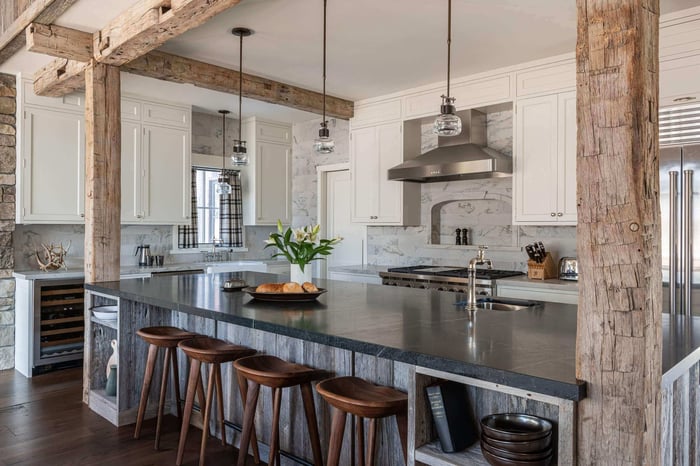
“It’s kind of a needle in a haystack situation,” Brinkerhoff said. “Each client has specific tastes. Some want narrow log faces, others prefer tall. Some want dovetail corners, others lap joints. And then there’s the texture. Hand-hewn versus round. We take all those parameters and then start the hunt.”
Before deconstruction, each log is carefully tagged so original joints and openings can be reconstructed with intent. The material then moves to Signature’s shop in Driggs, Wyoming, where a core crew evaluates each piece for rot, tightens oversized joints, and prepares the timbers for reinstallation.
“We tag the logs so they go back together as closely to the original as possible,” said Brinkerhoff. “Dovetail corners only work if the original fit is preserved. That tagging keeps the integrity intact.”
Installation follows techniques rarely seen in modern construction. Reclaimed timber facades are built from the top down to preserve the illusion of age.
“They start at the top because they want the appearance that it has been there for 150 years,” said Sam Stevens, Big-D Signature Director of Operations. “The last piece at the base, the shoe, can be a quarter or half log, but no one looks down there. Everyone looks up at the full courses above.”
Fresh cuts are aged in the field using blowtorches, vinegar, and hand tools so new work disappears into historic material. When reclaimed timbers are asked to carry structural loads, engineers are brought in to field verify and certify capacity, ensuring safety is never compromised.
“The majority of our structures use steel or engineered framing with timber wraps,” Brinkerhoff said. “But when we’re asked to make a 150-year-old timber structural, safety has to come first.”
Meanwhile, in the Midwest, McKee’s teams apply the same level of precision to contemporary custom home building. Kitchens feature paneled appliances, handcrafted millwork, and statement fixtures. Bathrooms and living spaces carry distinct palettes with no repetition, increasing coordination points with local trade partners.
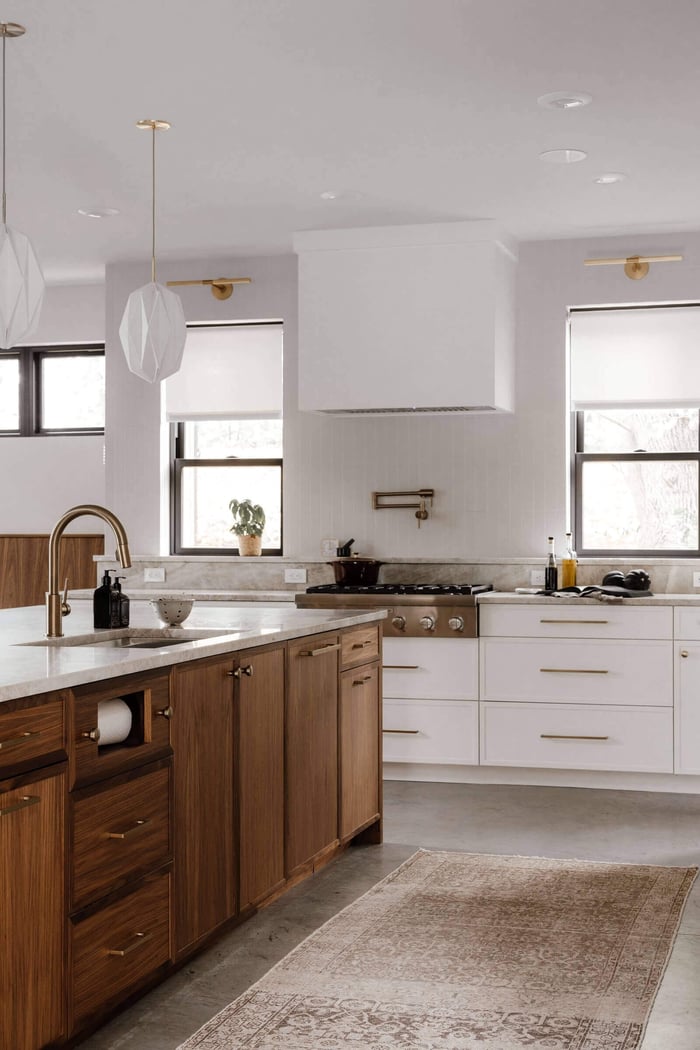
“It’s a smaller team and often a different sub pool than commercial or multifamily,” McKee said. “That means training them on our systems, safety, and quality expectations. We spend time keeping our thumb on the work, making sure every installation matches the standard.”
Whether it is reclaimed timber in the Tetons or a paneled refrigerator in Minnesota, the principle is the same. Details add up to trust.
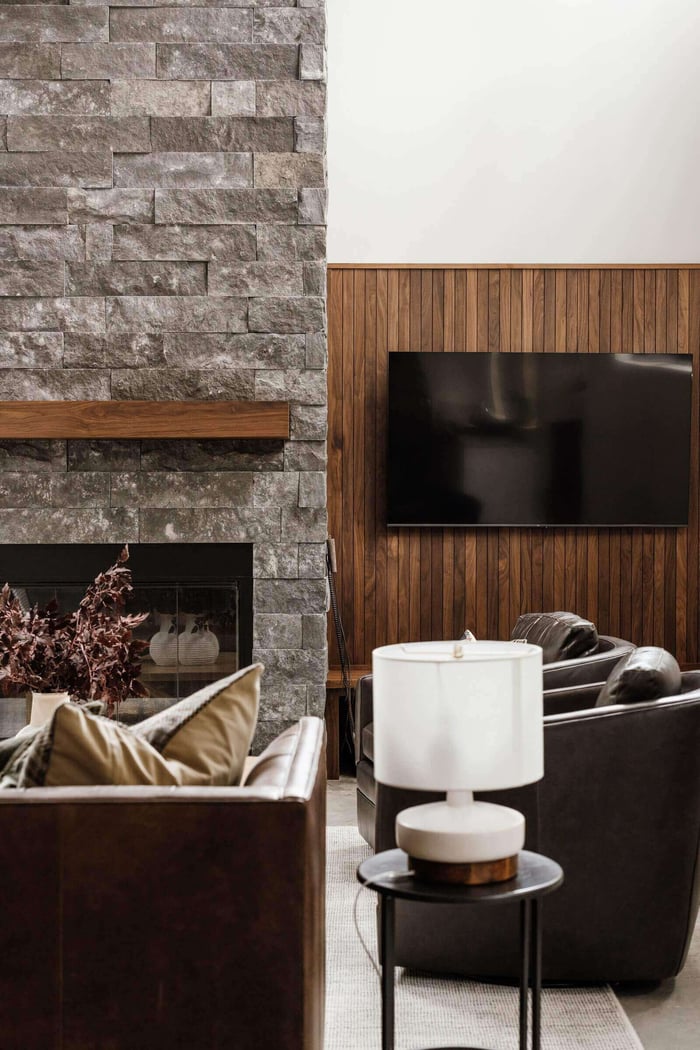
The true measure of luxury homebuilding is not the punch list. It is how the home feels in daily life. When craftsmanship is executed correctly, finishes fade into the background and the experience takes center stage. A kitchen feels calm because appliances blend into cabinetry. A bath feels indulgent because tile, lighting, and grout work in harmony. A living room feels timeless because reclaimed timber looks original while performing like new construction.
“I’ve always considered our timber crew kind of our SEAL Team 6,” Stevens said. “They’re amazing. They can make anything work, and every challenge they solve just adds to their experience.”
As McKee put it, “Everyone has their favorite spot in their home where they hang out. Our job is to make sure that when they are in their spot, they notice the craftsmanship that went into their home.”
Luxury homebuilding succeeds when every detail supports confidence. Owners trust the process, architects and designers draw with precision, and builders deliver work that feels inevitable.
Frequently Asked Questions
FAQs
What defines luxury construction in custom home building?
Luxury construction is defined by craftsmanship, precision, and intentional design rather than size or price alone. It prioritizes flawless execution, high-end materials, quality customer service, excellent communication, and collaboration between architects, designers, and builders to create homes that feel timeless and personal.
How is luxury construction different from production or spec home building?
Luxury construction moves at a heightened level across design, mock-ups, detailing, and approvals, and focuses on unique details in every space. Unlike production homes, no rooms or finishes are repeated, and quality standards are significantly higher, often requiring specialized trades and hands-on oversight throughout the build.
Why is craftsmanship so important in luxury residential construction?
Craftsmanship ensures that finishes, materials, and structural details perform as beautifully as they look. In luxury homes, even small imperfections are noticeable, so expert execution is critical to delivering long-term durability and visual harmony.
What role do architects and interior designers play in luxury home construction?
Craftsmanship ensures that finishes, materials, and structural details perform as beautifully as they look. In luxury homes, even small imperfections are noticeable, so expert execution is critical to delivering long-term durability and visual harmony.
What is reclaimed timber construction, and why is it used in luxury homes?
Reclaimed timber construction uses historic wood salvaged from old structures to create character-rich homes. Each log is evaluated, restored, and reinstalled with care, giving luxury homes a sense of authenticity while meeting modern performance and safety standards.
Is reclaimed timber structural or decorative in luxury construction?
It can be either. In many luxury homes, reclaimed timber is used as a decorative wrap over engineered framing. When timbers are structural, engineers verify load capacity to ensure safety while preserving the material’s historic character. It is up to engineers and consultants to use structurally approved materials, which requires more steps but results in quality construction.
How does a builder maintain quality when luxury homes require custom details?
Quality is maintained through close collaboration, specialized trade partners, and continuous field oversight. Luxury builders stay deeply involved in the work, adjusting schedules when needed to protect craftsmanship without compromising the final outcome. Luxury and quality go hand-in-hand.
similar articles
Cold-Weather Safety for Construction Workers
Feb 09, 2026As temperatures drop, cold-weather safety for construction workers becomes a front-and-center priority on our jobsites. Winter brings real risks, from
Why Veterans in Construction Excel
Feb 17, 2026The construction industry has always relied on people who can lead under pressure, solve problems in real time, and operate safely in complex
Proper Footwear for Construction Safety: Beyond the Boots
Feb 23, 2026Safety on a construction site starts from the ground up. While hard hats, vests, and eye protection often get the most attention, footwear for construction
Celebrating Women in Construction Week 2026
Mar 02, 2026Women in Construction Week 2026 is more than a date on the calendar. It is a national moment to recognize the women who are shaping skylines, leading